
One power unit. Five heads. Two pumps.
The set as it ships, item by item. Select an item to see the job it opens at the face, not a brochure line.
A concrete breaching set is one hydraulic power unit driving interchangeable heads, with two pumps for the water and the pressure. The heads break, shear, saw and drill reinforced concrete, stone and masonry where a machine-mounted breaker cannot reach.
The group, item by item
One coupling across every item, so a head is changed at the face instead of a machine being changed behind it.
Select an item. Arrow keys move through the group.
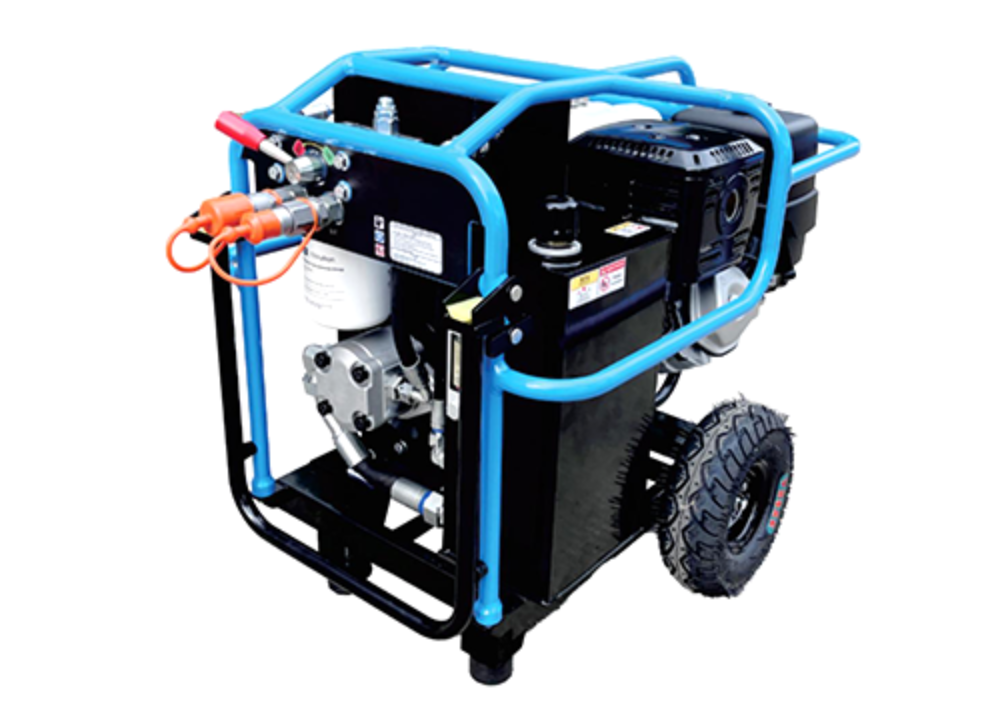
Hydraulic power unit
It builds pressure on start-up and drives several heads at once through separate outlets. No mains connection, so the group works in an outage area, a basement without supply or a site at night.
- Several heads driven at the same time
- No external power supply
- Wheeled frame, carried as one part
Breaker pick
Content to be added. Click to edit this product detail.
- Feature 1
- Feature 2
- Feature 3
Chain saw
Content to be added. Click to edit this product detail.
- Feature 1
- Feature 2
- Feature 3
Circular saw
Content to be added. Click to edit this product detail.
- Feature 1
- Feature 2
- Feature 3
Core drill
Content to be added. Click to edit this product detail.
- Feature 1
- Feature 2
- Feature 3
Ring saw
Content to be added. Click to edit this product detail.
- Feature 1
- Feature 2
- Feature 3
Intensifier pump
Content to be added. Click to edit this product detail.
- Feature 1
- Feature 2
- Feature 3
Slurry pump
Content to be added. Click to edit this product detail.
- Feature 1
- Feature 2
- Feature 3
The platform, stated plainly
One pressure standard, one coupling, one supplier. Numbers below are the platform figures; a specific cut depth is a question for the model sheet.
| Parameter | Value |
|---|---|
| Operating pressure, standard range | 70 MPa / 10,150 psi |
| Operating pressure, selected cutters | 72 MPa / 10,440 psi |
| Heads on the same coupling | Breaker pick, chain saw, circular saw, core drill, ring saw |
| Pumps supplied with the group | Intensifier pump, slurry pump |
| Power supply | Engine-driven unit; no mains connection on site |
| Carriage | Splits into parts carried by hand into stairwells, basements and shafts |
| Certification | CE marking; ISO 9001:2015 quality management at company level |
| Lead time | 15 to 30 days standard; 45 to 60 days for custom configuration |
Which item opens which job
Five jobs the group is bought for. Choose a job to bring the matching item up in the panel above.
Five jobsStanding water to thick reinforced sections
Open a folder to see the items that job uses. Each chip selects that item in the panel above and scrolls back to it.
Water in a basement, a pit or a shaft, carrying sand and stone chips. The pump moves it while the crew works, so the kerf stays visible.
Large stone and broken brick that cannot be lifted. Break it into pieces a person can carry out of the space.
Pavement repair, road patch and channel rework. Cut the line, lift the section and leave an edge a later trade can finish.
A load-bearing wall opened in a sequence the structure can take: cut the line first, then break between the cuts.
Deep sections with steel through them. Saw the kerf, take the steel, and break the concrete behind it.
Before the shift
The items that fail most often are couplings, strainers and fluid levels. All three are cheap to catch before the crew is committed.
Power unitFluid, hose and a run with no load
- Check fuel, engine oil and hydraulic oil levels, and top up before the shift, not at the face.
- Check hoses and couplings for cracks, ageing and any trace of a leak, including at the crimp.
- Confirm the filter element is clean; a restricted filter shows up as a slow head.
- Start the unit and let it build pressure with no head attached, listening for abnormal noise or judder.
Tool headsCoupling, seals and the working end
- Clear sand and debris out of the quick coupling before connection, and check the seal is intact.
- Check pick, blade, chain and segments for wear, chipping, missing teeth and slack.
- Confirm the housing has no crack; a cracked body is a stop, not a note for the end of the shift.
AccessoriesIntensifier and slurry pump
- Intensifier: check the oil circuit is sealed along its whole length.
- Slurry pump: clear the inlet strainer of sand and chips before start-up.
- Confirm the impeller turns free of jammed stone; a stalled impeller is a burned pump.
Ask for the configuration, not the catalogue
Tell us the material, the thickness, the reinforcement and the space you can get into. We will come back with the heads, the bar and the pump for that job.